
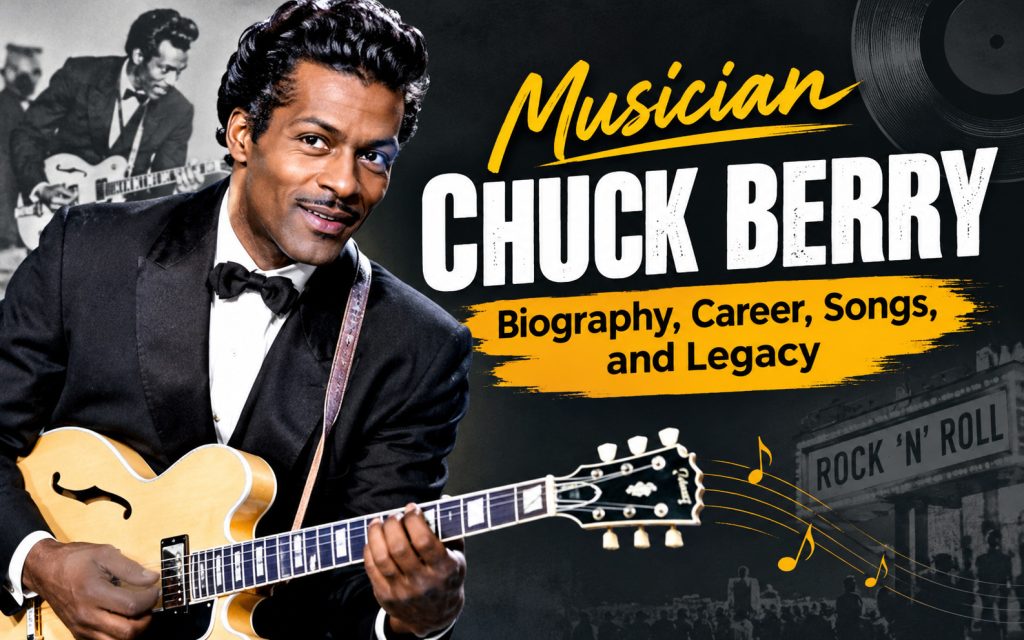
Musician Chuck Berry was an influential American singer, songwriter, and guitarist who helped shape the sound of rock and roll. Born on October 18, 1926, in St. Louis, Missouri, he became famous for energetic guitar performances, clever storytelling, and classic songs such as “Johnny B. Goode,” “Roll Over Beethoven,” and “Maybellene.” His distinctive musical style influenced generations of performers and helped establish the foundations of modern rock music.
Who Was Musician Chuck Berry?
Chuck Berry was a pioneering rock and roll musician whose songwriting, guitar playing, and stage performances helped define the genre during the 1950s. He combined elements of blues, rhythm and blues, country music, and popular music to create a sound that appealed to a broad audience.
Berry stood out because he wrote songs about everyday experiences, teenage culture, cars, school, romance, and independence. His lyrics often featured memorable characters and lively narratives, making his music accessible to listeners while showcasing his creativity as a songwriter.
His influence extended beyond his own recordings. Musicians including The Beatles, The Rolling Stones, and Jimi Hendrix drew inspiration from his approach to guitar playing, songwriting, or rock performance. Berry’s contribution to popular music earned him a lasting reputation as one of the foundational figures in rock and roll.
Early Life and Family Background
Chuck Berry was born Charles Edward Anderson Berry in St. Louis, Missouri, on October 18, 1926. He grew up in a middle-class African American family in a historically significant period when racial segregation shaped many aspects of American life.
His father, Henry William Berry, worked as a contractor and deacon, while his mother, Martha Bell Banks, was a schoolteacher. Berry grew up with siblings in a family that valued education, discipline, and community involvement.
How Did Chuck Berry Discover Music?
Berry developed an interest in music during childhood and attended Sumner High School, a prominent public high school for African American students in St. Louis. He began performing publicly while still a teenager, demonstrating an early interest in singing and entertaining audiences.
Gospel music, blues, and popular recordings influenced his musical development. He also became interested in guitar playing, an instrument that would eventually become central to his identity as a performer.
Berry’s musical ambitions developed alongside his everyday responsibilities and experiences. Before achieving national fame, he worked various jobs and learned how to perform for audiences in local venues.
Chuck Berry’s Life Before Fame
Berry’s early adulthood included both professional challenges and serious personal difficulties. In 1944, he was convicted of armed robbery after an incident involving three other teenagers and served time at a reformatory before being released in 1947.
After returning to civilian life, he worked in different occupations, including as a factory worker and a beautician after studying cosmetology. He also continued developing his guitar skills and performing locally.
These early experiences formed part of his personal history, although his eventual musical success came primarily through his songwriting, live performances, and recording career.
How Chuck Berry Became Famous
Chuck Berry rose to national fame in 1955 after signing with Chess Records and releasing “Maybellene,” a recording that brought his distinctive musical style to a wide audience. The song became a major hit and established him as one of the leading new voices in rock and roll.
The Success of “Maybellene”
Berry traveled to Chicago to meet Leonard Chess, co-founder of Chess Records, after receiving encouragement from blues musician Muddy Waters. Berry presented original material that combined rhythm and blues with country influences, a musical approach that helped distinguish him from many contemporary performers.
“Maybellene,” released in 1955, featured a fast rhythm, electric guitar, and a story about romance and a car chase. The song reached No. 5 on the US pop chart and No. 1 on the R&B chart, according to Berry’s official biography. Its success helped bring Chess Records into the mainstream popular music market.
The recording also demonstrated Berry’s talent for turning familiar experiences into engaging songs. Rather than relying only on romantic ballads or traditional blues themes, he created energetic music that reflected the interests and attitudes of young listeners.
His Rise During the 1950s
Following “Maybellene,” Berry released a succession of influential recordings, including “Thirty Days,” “Roll Over Beethoven,” “Too Much Monkey Business,” and “School Day.” These songs expanded his audience and helped establish a recognizable formula built around strong guitar riffs, rhythmic momentum, and memorable lyrics.
Berry’s music appealed to teenagers who were becoming an increasingly important audience for popular records. His songs frequently portrayed young people seeking independence, enjoying music, attending school, and navigating relationships. This subject matter helped make rock and roll a defining sound of youth culture in the 1950s.
Chuck Berry’s Most Famous Songs
Chuck Berry’s best-known songs combine distinctive guitar playing, memorable melodies, and lyrics that capture everyday American life. Many became standards of rock music and were later recorded by other major performers.
“Johnny B. Goode”
Released in 1958, “Johnny B. Goode” is widely regarded as one of Berry’s signature recordings. The song tells the story of a country boy with a remarkable talent for playing guitar who dreams of becoming a successful musician.
Its opening guitar riff is among the most recognizable sounds in early rock and roll. The song also explores the relationship between musical talent, ambition, and the possibility of achieving success despite humble beginnings.
“Johnny B. Goode” became especially significant beyond the music charts when a recording of the song was included on the Voyager Golden Record, launched aboard NASA’s Voyager spacecraft in 1977. The record was designed to carry selected sounds and music from Earth into space.
“Roll Over Beethoven”
Released in 1956, “Roll Over Beethoven” is another essential recording in Berry’s catalogue. Its lyrics humorously declare the arrival of rock and roll while referencing classical composer Ludwig van Beethoven.
The song’s driving rhythm and guitar work helped establish Berry’s musical identity. It also became an important recording for British rock musicians, particularly The Beatles, who performed and recorded Berry’s material during their early career.
“Rock and Roll Music”
Berry released “Rock and Roll Music” in 1957, celebrating the excitement of the emerging genre. The song presents rock and roll as music for dancing, entertainment, and shared enjoyment.
Its straightforward message and energetic arrangement made it well suited to live performances. The Beatles later recorded their own version, helping introduce Berry’s songwriting to another generation of listeners.
“Sweet Little Sixteen”
Released in 1958, “Sweet Little Sixteen” tells the story of a teenage fan who travels to see rock and roll performers and collects memories of concerts. The song reflects the growing popularity of live music, fan culture, and teenage audiences during the 1950s.
Its lyrics describe the excitement surrounding concerts and the social world of young music fans. The Beach Boys later adapted elements of its musical approach in “Surfin’ U.S.A.,” whose melody closely follows Berry’s “Sweet Little Sixteen.”
“Maybellene”
“Maybellene” remains central to Berry’s story because it introduced his songwriting and performance style to a national audience. Its blend of blues-based guitar, country influences, and fast-paced storytelling helped establish a musical template that he developed in later recordings.
The song also demonstrated how Berry could create a compelling narrative within a short popular recording. This ability to combine storytelling with a memorable musical hook became one of his defining strengths.
“My Ding-a-Ling”
“My Ding-a-Ling” became Berry’s only No. 1 single on the US Billboard Hot 100, reaching the top position in 1972. Unlike many of his earlier rock classics, the song was a humorous novelty recording built around double entendre and audience participation.
Its commercial success demonstrated that Berry could still reach a broad audience more than a decade after his first major hits. Although the song differs in style from his most influential early work, it remains an important part of his commercial history.
What Made Chuck Berry’s Musical Style Unique?
Chuck Berry’s musical style brought together blues phrasing, country influences, rhythmic guitar playing, and lyrics that described modern life. His approach helped establish conventions that later became fundamental to rock music.
His Signature Electric Guitar Sound
Berry developed a guitar style characterized by memorable riffs, sharp rhythmic accents, and energetic lead passages. A riff is a short musical phrase that repeats and helps define a song’s identity.
His playing drew on earlier blues guitar traditions while incorporating country-influenced melodies and a strong backbeat. This combination gave his recordings a distinctive sound that other guitarists could learn, adapt, and develop.
His famous guitar introduction to “Johnny B. Goode” illustrates his ability to make a short musical phrase immediately recognizable. Rather than treating the guitar merely as accompaniment, Berry placed it at the center of the performance.
The Famous Chuck Berry Duck Walk
Berry’s duck walk became one of the most recognizable stage movements in rock and roll. During the move, he bent his knees, lowered his body, and moved across the stage while playing guitar.
The duck walk added a visual element to his performances and helped make him a memorable entertainer. It also demonstrated how guitar playing and physical showmanship could work together in live rock music.
Although Berry did not invent every form of theatrical guitar performance, his use of the duck walk helped popularize it. Later performers adopted their own versions of energetic stage movements while playing electric guitar.
Storytelling Through Songwriting
Berry was an influential songwriter because he created vivid characters and narratives rather than relying exclusively on generalized romantic themes. His songs explored teenage independence, automobiles, school, travel, music, and social ambitions.
For example, “Johnny B. Goode” follows an aspiring guitarist, while “School Day” describes the frustrations of classroom life and the excitement of listening to music after school. These stories gave listeners characters and situations they could recognize.
Berry also used humor, conversational language, and carefully structured rhymes. His lyrics helped establish a model for rock songwriting that influenced artists who wanted to write about their own experiences and surroundings.
How Chuck Berry Influenced Other Musicians
Chuck Berry influenced generations of musicians by demonstrating how memorable guitar riffs, original songwriting, and energetic performances could define a rock and roll song. His work became a reference point for British and American rock bands that emerged during the 1960s and afterward.
The Beatles
The Beatles admired Berry’s songwriting and included his material in their early repertoire. Songs such as “Roll Over Beethoven” became part of the group’s connection to American rock and roll.
Berry’s combination of guitar-driven arrangements and narrative lyrics offered a model for musicians developing their own material. The Beatles also helped introduce his songs to listeners who might not otherwise have explored the original recordings.
The Rolling Stones
The Rolling Stones drew heavily on American blues and rock and roll, and Berry was an important influence on their musical development. Keith Richards, the band’s guitarist, has publicly acknowledged the significance of Berry’s playing to his own approach.
Richards also inducted Berry into the Rock & Roll Hall of Fame in 1986. The connection between the two musicians illustrates how Berry’s influence continued through artists who developed successful careers in later decades.
Jimi Hendrix and Other Guitarists
Berry’s energetic playing and memorable riffs helped establish a foundation that later electric guitarists could expand upon. Jimi Hendrix, among many other performers, worked within a rock tradition that Berry had helped shape.
His influence was not limited to guitar technique. Berry also showed musicians how to structure a song around a strong central riff, use instrumental passages to build excitement, and make a distinctive performance style part of an artist’s identity.
Why His Influence Still Matters
Berry’s songs continue to appear in performances, recordings, films, and discussions of rock history. His music demonstrates how a songwriter can combine existing traditions into a distinctive style that remains recognizable across generations.
His influence is particularly clear in the relationship between rhythm guitar, lead guitar, and vocals. Many rock performers who followed him used similar musical principles while introducing their own sounds and ideas.
Chuck Berry’s Awards and Major Achievements
Chuck Berry received major music honors during his lifetime, recognizing his contributions as a performer, songwriter, and influential figure in popular music.
His most notable achievements include:
- Rock & Roll Hall of Fame: Inducted in 1986 as part of the institution’s inaugural class.
- Grammy Lifetime Achievement Award: Received in 1985 in recognition of his lasting contribution to recorded music.
- Kennedy Center Honors: Recognized in 2000 for his contribution to American culture.
- Polar Music Prize: Awarded in 2014, acknowledging his international musical influence.
- Songwriters Hall of Fame: Inducted in 1986 for his work as a songwriter.
- Voyager Golden Record: His song “Johnny B. Goode” was included on the record launched into space in 1977.
These honors reflect different aspects of Berry’s career. Some recognize his technical and creative abilities, while others acknowledge the broader cultural impact of his music.
Chuck Berry’s Personal Life and Family
Chuck Berry’s personal life included marriage, parenthood, professional success, and significant legal controversies. Understanding these experiences provides a fuller picture of the person behind the music.
Marriage and Children
Berry married Themetta “Toddy” Suggs in 1948. The couple had four children: Darlin Ingrid Berry-Clay, Melody Exes Berry-Eskridge, Aloha Isa Lei Berry, and Charles Edward Berry Jr., according to his official website.
Despite the demands of touring and recording, Berry maintained a family life in the St. Louis area. His long association with the city remained an important part of his identity throughout his career.
His Life Outside Music
Before becoming a successful recording artist, Berry worked in several occupations, including factory work and cosmetology. His early professional experiences demonstrate that his path to fame was not immediate or guaranteed.
As his career progressed, he became known for maintaining a strong connection to St. Louis. He also performed regularly at local venues, including Blueberry Hill, where his appearances became an enduring part of the city’s musical culture.
Chuck Berry’s Legal Troubles and Controversies
Berry’s legacy includes serious legal issues that should be considered alongside his musical achievements. His career was interrupted at various points by criminal convictions, imprisonment, and other controversies.
The 1944 Armed Robbery Conviction
In 1944, Berry was convicted of armed robbery following an incident involving other teenagers. He served time at the Intermediate Reformatory for Young Men in Algoa, Missouri, before being released in 1947.
This episode occurred before his professional music career began. After his release, Berry returned to St. Louis, worked to support himself, and continued developing his musical interests.
The 1959–1960 Legal Case
In 1959, Berry was arrested under the Mann Act following an incident involving a teenage girl whom he had brought across state lines to work at his club in St. Louis. He was convicted in 1960, and the conviction was upheld after a retrial in 1961. He served approximately 20 months in prison.
The case interrupted his career during a period when he was one of rock and roll’s most prominent recording artists. It also remains an important part of his biography because it illustrates that his public success coexisted with serious legal consequences.
Why His Controversies Matter to His Legacy
Berry’s musical achievements do not erase the significance of his personal conduct or legal history. A balanced account recognizes both his contribution to popular music and the documented controversies that affected his life.
His story is therefore more complex than a simple account of fame and success. Understanding the full biography allows readers to appreciate his artistic influence without overlooking difficult aspects of his personal history.
Chuck Berry’s Later Career and Final Album
Chuck Berry continued performing and recording for decades after his breakthrough in the 1950s, although his later career included fewer major hits than his early years. His enduring popularity allowed him to remain an important figure in rock music long after its original era.
Music and Performances in the 1970s and 1980s
The success of “My Ding-a-Ling” in 1972 gave Berry his first and only No. 1 single on the Billboard Hot 100. He continued touring, making television appearances, and performing his best-known songs for audiences around the world.
In 1979, Berry performed at the White House for President Jimmy Carter. During the 1980s, his influence received further recognition through major music honors and the release of the documentary Hail! Hail! Rock ‘n’ Roll, directed by Taylor Hackford and released in 1987. The film features Berry performing with musicians including Keith Richards and Eric Clapton.
The Album CHUCK
Berry’s final studio album, CHUCK, was released on June 9, 2017, after his death. It was his first studio album of new material since 1979 and included contributions from members of his family and other musicians.
The album demonstrated that Berry had continued working on music during his later years. Its release gave listeners an opportunity to hear new recordings from an artist whose most influential work had appeared several decades earlier.
When Did Chuck Berry Die?
Chuck Berry died on March 18, 2017, at the age of 90 in St. Charles County, Missouri. His death marked the end of a career that had helped shape the development of rock and roll from the 1950s onward.
Authorities responded to a medical emergency at his home, where he was pronounced dead. His death prompted tributes from musicians, public figures, and fans who recognized his influence on modern popular music.
Berry’s passing also renewed interest in his recordings and his place in rock history. His songs remained widely known, and his guitar style continued to be studied by musicians interested in the foundations of the genre.
Interesting Facts About Musician Chuck Berry
Chuck Berry’s career included several unusual achievements and milestones that help explain why his name remains important in music history.
- His real name was Charles Edward Anderson Berry: Chuck was the name by which he became internationally known.
- He helped define rock and roll: His recordings combined elements of rhythm and blues, country music, and electric guitar-driven performance.
- “Johnny B. Goode” went into space: The song was included on the Voyager Golden Record in 1977.
- He was a skilled storyteller: Many of his songs followed characters through everyday situations involving school, romance, travel, and ambition.
- He received major international recognition: His honors included the Grammy Lifetime Achievement Award, Kennedy Center Honors, and Polar Music Prize.
- His duck walk became famous: The movement became one of his most recognizable stage trademarks.
- He maintained a connection to St. Louis: His hometown remained central to his personal identity and musical career.
Frequently Asked Questions About Chuck Berry
Why is Chuck Berry called the Father of Rock and Roll?
Chuck Berry is often called the Father of Rock and Roll because his guitar playing, songwriting, and stage performances helped establish the genre’s defining characteristics. His music influenced artists who developed rock into one of the world’s most popular musical forms.
What was Chuck Berry’s biggest hit?
“Johnny B. Goode” is arguably his most iconic song, but “My Ding-a-Ling” was his only single to reach No. 1 on the US Billboard Hot 100. “Maybellene” was his breakthrough hit in 1955.
What was Chuck Berry’s first major hit?
“Maybellene,” released in 1955 through Chess Records, was Berry’s first major national hit. It reached No. 5 on the US pop chart and No. 1 on the R&B chart.
Did Chuck Berry influence The Beatles and The Rolling Stones?
Yes. Both bands drew inspiration from Berry’s music, and each performed his songs. His songwriting, guitar riffs, and energetic rock and roll style helped influence the development of British rock music.
How old was Chuck Berry when he died?
Chuck Berry was 90 years old when he died on March 18, 2017. He was born on October 18, 1926, in St. Louis, Missouri.
Was Chuck Berry inducted into the Rock & Roll Hall of Fame?
Yes. Berry was inducted in 1986 as part of the Rock & Roll Hall of Fame’s inaugural class. His induction recognized his major contribution to the formation and development of rock and roll.
What was Chuck Berry’s last album?
His final studio album was CHUCK, released on June 9, 2017, after his death. It was his first studio album of new material since 1979.
Conclusion: The Lasting Legacy of Musician Chuck Berry
Musician Chuck Berry helped transform American popular music through his distinctive guitar playing, memorable songwriting, and energetic performances. From “Maybellene” and “Roll Over Beethoven” to “Johnny B. Goode,” his recordings established musical ideas that generations of rock artists continued to develop.
Although his life included significant legal controversies, his contribution to rock and roll remains central to music history. His influence can be explored further through the history of Chess Records, the rise of 1950s rock and roll, and the musicians who carried his musical ideas into later decades.